


The increased daily touchpoints that we all have in using supportive AI tools, and generative AI tools, via the ever evolving AI chatbots, is not new news. It’s commonplace and will now always be in our lives. Brands and marketing specialists are deep in thought (human thought for the time being…) in how this impacts their investment into their marketing and advertisement. And at Active International, we’re always working at how to support our clients via Corporate Trade, and maximising their marketing ROI.
The web as we know it is changing, and is undergoing its biggest shift since Google launched. Generative engines are increasing becoming the ‘front door’ to information (Chat GPT, Google Gemini, Microsoft CoPilot, Perplexity, and the like). Chat GPT alone now has 114 million daily active users, and processes 2.5 billion daily queries. (A huge question on the sustainability of this will grow of course).
Google’s Paid Search has long been a dependency as a digital marketing channel for brands of all shapes and sizes at the ‘front door’. And so has the specialism of Search Engine Optimisation (SEO): working hard to organically maximise your brand and product visibility the search engine results. However, online search engines are now evolving (or they’re on their way out to meet Blackberry and MySpace in the internet afterlife, up in the cloud somewhere), and soon the days will be gone when us mere humans search for something and have to look through 20 blue website links to decide how to satisfy our thirst for information. Or to buy a new torch, in my case.
So this brings in the new acronym GEO, Generative Engine Optimization, the successor to SEO and very likely to paid search as well. GEO will fundamentally alter discoverability, monetisation, and the economics of the internet: GEO is about being “model-visible”, not “search-visible”. Being present in the new internet experience.
- SEO = ranking signals, backlinks, organic visibility optimisation.
- GEO = trust signals, AI model ingestion, alignment with an AI model’s “worldviews”, and being consistently and regularly corroborated across the web
GEO encompass sponsored content and paid advertising formats, but also AI engines organically presenting brands and their products – by information available to them on the open internet, or via data feeds directly from brands / advertisers. Brands will have to rethink how they invest and measure being in the right place, at the ‘front door’ of the internet; through paid advertising; or through organically being visible within AI chatbots.
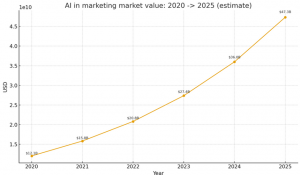
An estimate on the global level of marketing spend into AI.
There are of course huge implications on the experience and overall culture in us using AI engines as commonplace – what is our trust going to be as a user in these chatbots, if ads are appearing and the responses include brand or product placements? What if we have “conversational advertising” with every request we use AI for? Brands will have to marry up being visible, whilst not impacting their reputation negatively.
In conclusion, GEO will be as fundamental in 2026-2030 as SEO was in the mid 2000’s. There are potentially game changing implications for brands; expertise and talent; testing and learning; brand and product messaging; retaining marketing performance; onsite performance. Their whole paid search and SEO strategy is about to be ripped up. And this of course bottoms down to cost, and the risk of a negative ROI impact – or equally a huge opportunity to stand out and take a bigger share in the new internet.
Corporate Trade, or Media Barter, has always offered solutions in maximising digital marketing investments and ROI. Active International aim to always be ahead of the curve, and are investing in AI talent and expertise, and increased digital, technology and data services. Active is here to help with commercial solutions across all digital investments, during these changing times.

